
Nursing
Fall 2026 Nursing Application
Application period has ended
-
Family Welcome Day 6/9/26 12-4pm
-
Mandatory In-person Orientation Day 1 6/10/26 9-1pm
-
Mandatory In-person Orientation Day 2 6/11/26 9-4pm

Application Support Q&A Sessions
June TEAS test information
Visit the TEAS info page for test date and instructions.
Nursing at Chabot College
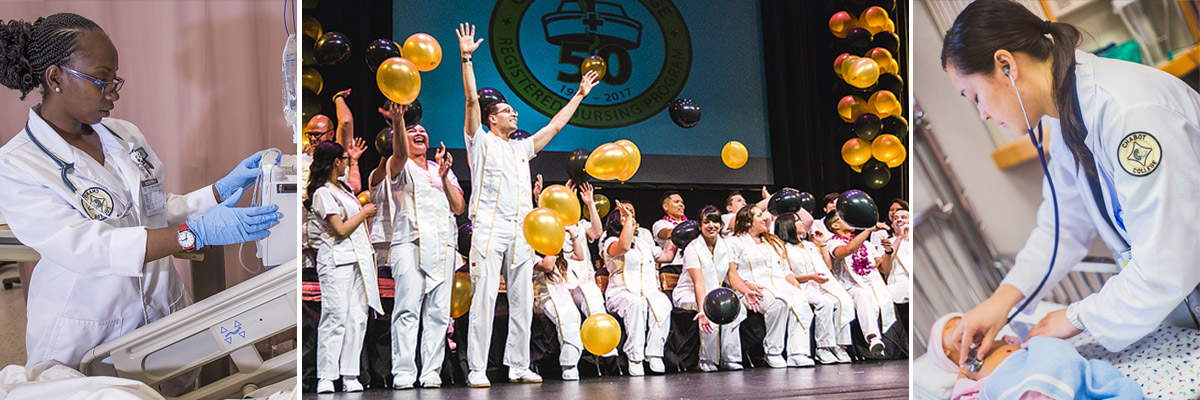
The Nursing Program provides the necessary knowledge and skills on becoming a Registered Nurse (RN). Nursing continues to be a popular job and is in very high demand. If you're ready to take the next step of becoming one, our Nursing program can help you get there.
The Nursing Profession Needs You!
Attend the How to be Successful in a Nursing Program class:
NURS 10, 0.5 units or Pass/No Pass
2 sections available:
- CRN# 22538 on September 19 & 20
- CRN# 22539 on November 7 & 8
This course introduces students to the rigors and curriculum in the Nursing Program. Students prepare to be SUCCESSFUL by learning about topics such as critical thinking, study skills, time management, nursing theory, math for medication, and the nursing process.
Open to ALL Chabot students interested in pursuing a degree in nursing!
Register in MyPortal
For more information or to request accommodations, email rnprogram@chabotcollege.edu
Why Chabot
- Faculty with 20+ years of experience
- Modern facilities and simulation labs preparing students with real life scenarios
- Dedicated counselor for the nursing program
- We work with diverse populations and communities in the clinical settings
- 50-75% of graduates transfer to a BSN program or the CSUEB bridge program
- Test-taking preparation seminars
- Affordable
- Ranked #1 Program in California 2023 from for the 5th Annual Nursing School Program rankings by RegisteredNursing.org.
- Exemplary NCLEX passing rate:
Year of Graduating Class Passing Rate Class 2023 (31) 100% Class 2022 (33) 95.65% Class 2021 (31) 96.97% Class 2020 (22) 100% Class 2019 (29) 100%
We offer 2 programs
- Registered Nursing
Acquire an AS Degree in Nursing and qualify to take the NCLEX-RN. - LVN to RN Bridge
Provides LVNs two options (30 unit and/or AS degree) to qualify on becoming a RN, pending available space. Average incoming LVN class size is 3-5 students annually.
Foreign Trained Registered Nurses
If you have been referred to take specialized classes by the BRN, unfortunately, Chabot
Nursing can no longer accommodate this request.
Opportunities
Registered Nurses are projected to receive an average yearly wage from $68,199 to $122,284 in Alameda County as of April 2021. The outlook for RNs will continue to be positive.
Many of our graduates work at Bay Area health facilities in various positions and even return to Chabot's Nursing Program to assist current students. Our program offers a pathway for students to becoming Registered Nurses and to take advantage of these opportunities.
 Building 2200, Room 2273 - 2nd fl
 510.723.6896

 HOURS
HOURS
In person:
Available by appt. M-F
Online:
- Monday - Friday: 9 - 5
Hours are subject to change
Tami Washington
Director of Nursing Program

FUNDRAISING
Nursing Program is raising funds to help students cover the cost of clinical supplies, program material, graduation, and other educational needs. Make a tax-deductible contribution today and help support Chabot's nursing students!